
SEO in 2025 is no longer about best guesses or short-term tricks. The digital landscape has evolved dramatically, and so have search engines, users, and competitors. Strategies like keyword stuffing, quick backlinks, and generic content are now outdated. They can even harm your rankings. If you’re still relying on outdated SEO practices or guessing your way to the top, you’re already falling behind. Your competitors are using smarter, data-driven strategies to get ahead.
In today’s digital world, SEO services must be data-driven, strategic, and adaptable. From AI SEO tools and LLM optimization to hyper-local SEO in regions like Pakistan, success doesn’t happen by accident. Every step needs strategy, focus, and smart execution. This blog explores why strategy is the heart of successful SEO in 2025. It also highlights the essential services, tools, and techniques you need to thrive.
Search Has Changed. Strategy Is Now Mandatory.
There was a time when adding a few keywords to your content was all it took to climb the rankings. Buying backlinks made the process even faster. That time is long gone. Search engines today use complex algorithms powered by artificial intelligence to understand the intent behind every query. They also analyze content context and user behavior signals like click patterns and dwell time.
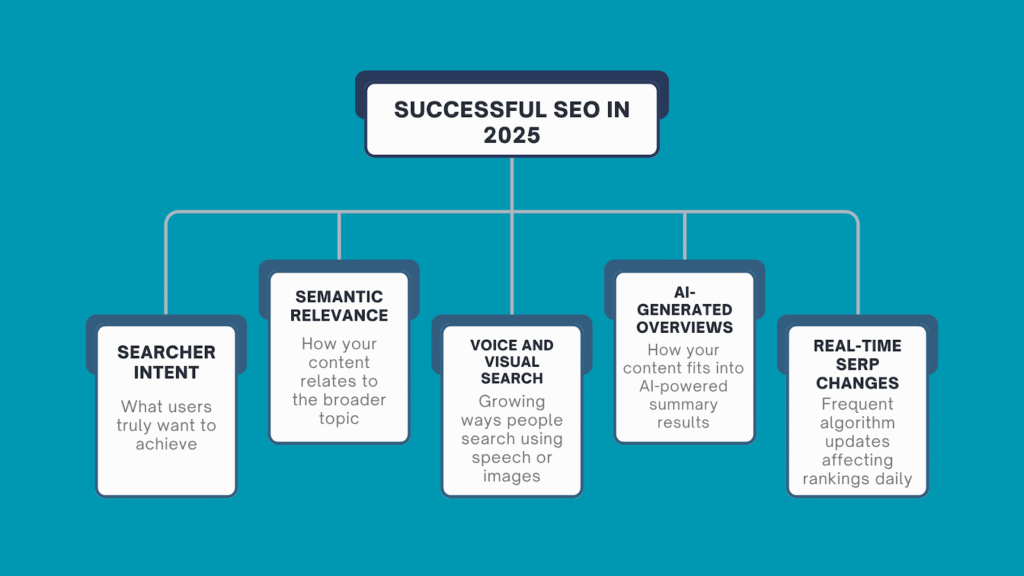
In 2025, a successful SEO plan goes well beyond keywords it factors in:
- Searcher intent what users truly want to achieve,
- Semantic relevance how your content relates to the broader topic,
- Voice and visual search growing ways people search using speech or images,
- AI-generated overviews how your content fits into AI-powered summary results,
- Hyper-local personalization tailoring results for precise locations, and
- Real-time SERP changes frequent algorithm updates affecting rankings daily.
Trying to “wing it” today is like showing up to a chess match without knowing the rules. Without strategy, you’re just guessing and guessing rarely wins.
What’s Driving the Shift?
AI-Powered Search Engines
Search isn’t just about indexing keywords anymore. AI SEO has revolutionized how engines understand and deliver content. Google’s Search Generative Experience (SGE), ChatGPT integrations, and platforms like Perplexity AI now deliver summarized answers right in search results. As a result, users no longer need to click through to find what they’re looking for. This shift means:
- Users often don’t click traditional links anymore,
- Visibility depends on Entity SEO establishing your brand or content as a recognized topic or authority,
- Content must be optimized to feed AI engines with clear, structured information,
- Structured data, context, and relevance now matter more than keyword density alone.
SEO today requires Generative Engine Optimization, a newer discipline you can’t master by guessing. For example, if you run an e-commerce site, you might optimize your product pages for more than just keywords. Adding structured data helps Google’s AI easily parse your content for rich, summarized snippets.
Zero-Click and Visual SERPs
Zero-click searches are increasing, meaning users get their answers directly on the search results page without clicking a link. Google’s featured snippets, “Snack Pack” maps, rich results with schema, video embeds, and AI summaries all contribute to this trend. For businesses, this means you need to optimize for visibility not just traditional ranking position. Video SEO, Google My Business SEO Services optimization, and local SEO are crucial now. For example, a restaurant in Karachi might focus on Google Maps SEO and local reviews to appear in the local snack pack, capturing attention without a click.
Algorithm Updates & Search Volatility
Google rolls out updates more frequently and aggressively than ever. Without a clear strategy, your site’s rankings can drop suddenly sometimes with no explanation. Guesswork leads to wasted time and resources chasing short-term wins or reacting blindly to algorithm changes. Instead, your SEO plan must include:
- Regular technical SEO audits,
- Content performance tracking,
- Monthly SEO service adjustments,
- Competitor monitoring to stay ahead.
Imagine your competitor suddenly climbing in ranking for your main keywords. Without strategic tracking, you might miss the reason and fail to react in time.
The SEO Stack You Need in 2025
A strategic SEO approach requires a comprehensive stack of services tailored to modern search behavior:
Technical SEO Services
Your website must be crawlable, fast, and error-free before anything can rank. Technical SEO Optimization Services ensures the search engines can efficiently index your site and users have a great experience. Key priorities include:
- Logical site structure and indexing for smooth crawling,
- Optimizing Core Web Vitals (page loading speed, interactivity, and visual stability),
- Improving website speed, especially on mobile,
- Disavowing toxic backlinks that could harm your ranking,
- Ensuring mobile-friendliness to accommodate mobile-first indexing,
- Implementing schema markup to help search engines understand your content better.
Popular tools like Google Search Console, Screaming Frog, GTmetrix, and PageSpeed Insights help monitor and fix issues.
On-Page SEO Services
On-Page SEO aligns your content with search intent and relevance. This involves:
- Crafting keyword-optimized title tags, headers, and meta descriptions,
- Writing semantically-rich content with LSI (latent semantic indexing) keywords,
- Creating internal links that form topic clusters for better site architecture,
- Adding alt text and compressing images for accessibility and speed,
- Maintaining clean, descriptive URLs.
Plugins such as Yoast SEO, Rank Math, and AIOSEO streamline these optimizations.
Content Writing Services for SEO
In SEO for 2025, content is still king. But it only works if it’s high-quality, user-centric, and optimized for AI-driven ranking. Content must:
- Accurately match user intent, whether informational, transactional, or navigational,
- Be updated frequently to stay relevant,
- Address AI-powered search engines like Gemini and Perplexity by structuring data clearly,
- Balance writing for both humans and machines.
Examples include B2B guides and product descriptions for eCommerce sites. Blog posts can also be optimized for ChatGPT-like AI search assistants.
Keyword Research Services
Guessing keywords is no longer an option. Data-driven keyword research is essential, focusing on:
- Long-tail keywords with lower competition,
- Question-based search phrases,
- Differentiating transactional vs. informational intent,
- Localized keywords such as “SEO services Karachi,”
- Seasonal trends and rising phrases.
Keyword and competitor analysis tools like Ahrefs, SEMrush, Ubersuggest, and Google Trends are essential. They help uncover valuable opportunities for growth and optimization.
Link Building Services
While backlinks remain a key ranking factor, quality trumps quantity. Key strategies include:
- Earning backlinks through guest posts on relevant industry sites,
- Building relationships with authoritative domains,
- Using dofollow links strategically,
- Employing white-hat tactics and disavowing spammy backlinks.
In link-building services focused on boosting domain authority, strategy is everything. Avoid shortcuts like buying links, as they can cause penalties and long-term harm.
Local SEO Services
Local SEO is more competitive than ever. Businesses must focus on:
- Google Business Profile optimization,
- Consistent NAP (Name, Address, Phone number) data across directories,
- Local citations and reviews,
- Geo-targeted content and keywords.
Platforms like BrightLocal, Moz Local, and Whitespark help manage and improve local rankings effectively. This is especially valuable in markets like Pakistan, where local search is growing rapidly.
eCommerce SEO Services
For online stores, SEO in 2025 requires scalable frameworks including:
- Optimized product pages with unique descriptions,
- Category and collection page SEO,
- Shopify and WooCommerce-specific optimizations,
- Product schema to enhance rich snippets,
- Image alt text and compression to speed up loading,
- Conversion rate optimization tied to SEO traffic.
Apps and plugins automate these processes, helping large stores maintain SEO at scale.
B2B SEO Services
Business-to-business SEO, B2B SEO services to generate leads revolves around building trust and authority:
- Creating top-of-funnel content like guides and whitepapers,
- Developing bottom-funnel landing pages optimized for conversions,
- B2B-specific keyword targeting,
- Aligning content with platforms like LinkedIn for maximum reach.
Tools such as SEMrush, HubSpot SEO tools, and Leadfeeder enable tracking and lead generation aligned with SEO efforts.
SEO Tools You Need to Use
You can’t execute a strategic SEO plan without the right tools. Some of the top options in 2025 include:
| Tool | Use Case |
| Ahrefs | Backlink analysis, content gap, keywords |
| SEMrush | Site audits, keyword tracking |
| ChatGPT | Content briefs, titles, metadata |
| Surfer SEO | NLP scoring, on-page optimization |
| Screaming Frog | Technical site audits |
| BrightLocal | Local rankings and citations |
| Frase.io | AI content research and outline creation |
Using these tools allows you to make data-driven decisions rather than relying on guesswork.
Strategy First: Why Guessing Doesn’t Work
SEO is now about intent rather than just keywords. Let’s compare two approaches:
| Guesswork SEO | Strategic SEO |
| “Let’s try this keyword” | “This keyword has 5,000 searches, low KD, and high CTR” |
| “We need more content” | “We need content around our product funnel” |
| “Just build some links” | “Earn backlinks from niche-relevant, authoritative domains” |
| “Hope we rank” | “Track CTR, dwell time, backlink velocity, and adapt” |
Strategic SEO services use competitor analysis, AI tools, and constant data monitoring to drive every decision.
What to Track in 2025
To measure success, don’t just watch rankings. Monitor:
- Organic traffic growth,
- Keyword visibility by funnel stage,
- Appearances in schema-rich snippets,
- Conversions attributed to SEO,
- Technical site health,
- Bounce rates and dwell time,
- Click-through rates (CTR) on titles and meta descriptions.
Tracking these metrics helps you continuously tweak and improve your SEO strategy for sustainable growth.
| Metric | What It Tells You |
| Organic Traffic Growth | Measures increase in visitors coming through unpaid search results. |
| Keyword Visibility by Funnel Stage | Shows how well you’re ranking across awareness, consideration, and decision keywords. |
| Schema-Rich Snippet Appearances | Indicates if your content is optimized for enhanced SERP features. |
| Conversions Attributed to SEO | Tracks how many leads/sales result directly from SEO-driven traffic. |
| Technical Site Health | Evaluates site speed, mobile-friendliness, crawl errors, and indexability. |
| Bounce Rate & Dwell Time | Measures engagement and relevance of your content. |
| Click-Through Rates (CTR) | Assesses effectiveness of your titles and meta descriptions in attracting clicks. |
Final Thoughts: Strategy Wins, Guesswork Fails
SEO in 2025 is more complex but also more rewarding than ever before. Real growth comes from clarity, planning, and consistent execution. Whether you run a B2B startup, a Local SEO company, or a large eCommerce brand, you need:
- A thorough technical SEO audit,
- Ongoing monthly SEO services,
- Expert SEO copywriting and content planning,
- Reliable, white-hat link building and authority growth,
- Tools to track and adapt every month.
- Brand visibility depends on Entity SEO
Stop relying on hope or outdated practices. Start building SEO with purpose and strategy.
Ready to Make SEO Work for You in 2025?
Let’s create a custom SEO plan built on your goals, market, and competitors. Whether you’re looking for white-label SEO, AI optimization, or local SEO in Pakistan, we’ve got you covered. Our strategies help you outrank and outperform your competition without the guesswork.
FAQs
Does SEO still matter in 2025?
Absolutely, SEO in 2025 is more important than ever. With rising competition and the surge of AI-generated content, staying visible online is getting harder. That’s why businesses now need strategic SEO services to maintain their edge. Guesswork no longer works success depends on data-driven planning, optimized content, and smart use of AI SEO tools.
What is the best SEO strategy for 2025?
The best strategy involves combining technical SEO, content writing services, and AI-powered keyword research. Focus on search intent, user experience, and real-time data to guide your SEO efforts. Use tools like SEMrush, ChatGPT for SEO, and Surfer SEO to build a scalable, conversion-driven framework.
Why is local SEO important in 2025?
Local SEO in 2025 ensures your business appears in Google Maps, snack packs, and mobile searches. With zero-click results increasing and SERPs becoming more personalized, businesses need to stand out locally. Local SEO services in Pakistan help you target nearby customers, increase foot traffic, and strengthen your presence with localized content and citations
What is the difference between old SEO and new SEO?
Old SEO relied on keyword stuffing, backlink spamming, and basic metadata. Modern SEO in 2025 is about user intent, structured data, AI optimization, and rich media. You now need SEO strategies built on semantic relevance, speed, mobile UX, and adaptability to algorithm updates.
What is the future of SEO after AI?
AI won’t kill SEO, it’s reshaping it. The future lies in optimizing for AI SEO like Gemini and Perplexity. Use Entity SEO, structured content, and generative engine optimization to stay relevant. Human creativity, strategy, and real value will always be core to effective SEO services.
What’s the best SEO strategy?
A layered strategy is best. Combine on-page SEO, link building services, and technical audits. Tailor your plan to user behavior and intent. Use SEO Tools like Ahrefs, and BrightLocal to guide content and track performance. Focus on Proven SEO Strategies to Grow Organic Traffic, and avoid shortcuts prioritize long-term, strategic growth.
Which SEO tool is better?
There’s no one-size-fits-all. For backlinks and research, use Ahrefs. For site audits, SEMrush or Screaming Frog. For content scoring, Surfer SEO. For Local SEO, use BrightLocal . For AI support, try ChatGPT for SEO etc. The right tools depend on your SEO goals and niche.