
Introduction
In today’s fast-paced digital world, businesses need SEO strategies that grow with them. Simple fixes or one-off campaigns don’t cut it anymore. You need Scalable SEO services that adjust as your business evolves. Whether you are a B2B company, an eCommerce store, or somewhere in between, your SEO must be flexible. It has to handle new markets, fresh products, and changing customer behaviors without losing steam. This blog explains how AI SEO Solutions, B2B SEO Strategies, and E-Commerce SEO Services power modern growth engines. We’ll also cover why technical SEO and link building are critical to scaling your online presence.
The Need for Scalable SEO
The digital landscape changes fast. Algorithms update. User search habits shift. Your competitors keep innovating. A static SEO plan can’t keep up with these shifts. It may work short-term but will lose traction over time. That’s why businesses need Scalable SEO services. Scalable SEO lets you:
- Expand your keyword universe without starting over.
- Enter new industries or regions smoothly.
- Adjust content quickly based on data.
- Use automation to save time and reduce errors.
In short, it helps you grow steadily and sustainably.
AI: The Heart of Scalable SEO
Artificial intelligence is no longer a buzzword; it’s a practical tool for SEO growth. AI SEO Solutions analyze massive datasets instantly. They find keyword opportunities and uncover trends before they become obvious. This gives you a huge advantage over competitors who rely only on manual research. AI also improves content optimization. It helps create relevant titles, meta descriptions, and page structures that align with search intent. For eCommerce, AI can optimize product pages at scale, making sure every item has SEO-friendly descriptions and tags. Additionally, AI-powered tools can handle technical SEO checks like crawl errors, broken links, and site speed issues, keeping your site healthy as it grows. However, AI is best when paired with human expertise. It automates routine tasks but leaves strategy and creativity to your SEO team.
Scalable B2B SEO Strategies
B2B marketing involves long sales cycles and complex decision-making. Your SEO needs to speak directly to business buyers. B2B SEO services focus on creating content that addresses pain points, industry challenges, and ROI. White papers, case studies, and detailed service pages are common tactics. With scalable SEO, you can create tailored campaigns for different buyer personas or industries. For example, one campaign might target IT managers, while another targets procurement officers. Enterprise SEO strategies often include account-based SEO, which personalizes content for key companies you want to attract. Scaling B2B SEO means expanding these efforts across multiple sectors and regions, all while maintaining precise targeting.
Driving eCommerce SEO at Scale
eCommerce businesses face unique challenges. They often manage thousands of product pages that require constant updating. E-commerce SEO services optimize product titles, descriptions, images, and category pages to boost organic traffic. Scalability is crucial here; manual SEO for each product isn’t realistic. AI tools can automate alt-text creation, keyword insertion, and seasonal content updates. This frees your team to focus on bigger-picture strategies, like improving site architecture and user experience. Moreover, optimizing for long-tail keywords helps capture buyers at different stages, from casual browsers to ready-to-purchase customers.
| Section | Details |
| Topic | Driving eCommerce SEO at Scale |
| Challenge | Managing thousands of product pages that require constant updates |
| Core Service | E-Commerce SEO Services optimize product titles, descriptions, images, and category pages to increase organic traffic |
| Scalability Issue | Manual SEO for each product is unrealistic |
| AI Role | Automates alt-text creation, keyword insertion, and seasonal content updates |
| Team Benefit | Frees team to focus on site architecture and user experience improvements |
| Keyword Strategy | Optimize for long-tail keywords to target buyers from casual browsing to purchase readiness |
Technical SEO: Building a Strong Foundation
You can’t scale SEO without solid technical SEO. Technical SEO optimization services include fixing site speed, ensuring mobile-friendliness, and making sure your pages are easily crawlable by search engines. When your website grows rapidly, these technical elements become even more important. A slow or poorly indexed site loses rankings fast. Automation tools monitor your site’s health, report crawl errors, and track indexing status. A regular technical SEO audit keeps problems from piling up. Structured data, like schema markup, helps search engines understand your content better. This can boost your chances of appearing in rich snippets and featured results.
The Role of Link Building
Backlinks remain a major ranking factor. But not all links are equal. Effective link-building services focus on gaining high-quality, relevant backlinks that boost your domain authority. At scale, AI can help identify the best link opportunities. Still, outreach requires a personal touch. Building genuine relationships with industry bloggers and influencers pays off in the long run. Guest blogging, partnerships, and PR campaigns are common tactics for acquiring valuable backlinks.
Measuring Success and Iterating
Scalable SEO is all about measurement and adjustment. Track metrics like:
- Organic Traffic Growth
- Keyword ranking improvements
- Conversion rates from organic search
- Cost per acquisition (CPA)
- Customer lifetime value (CLV)
Use this data to refine your strategy. If a keyword loses traffic, replace it with a better one. If a page performs well, build more content around that topic. Automation and AI tools speed up this analysis. They give you quick insights to act on before competitors catch up.
Common Mistakes to Avoid When Scaling SEO
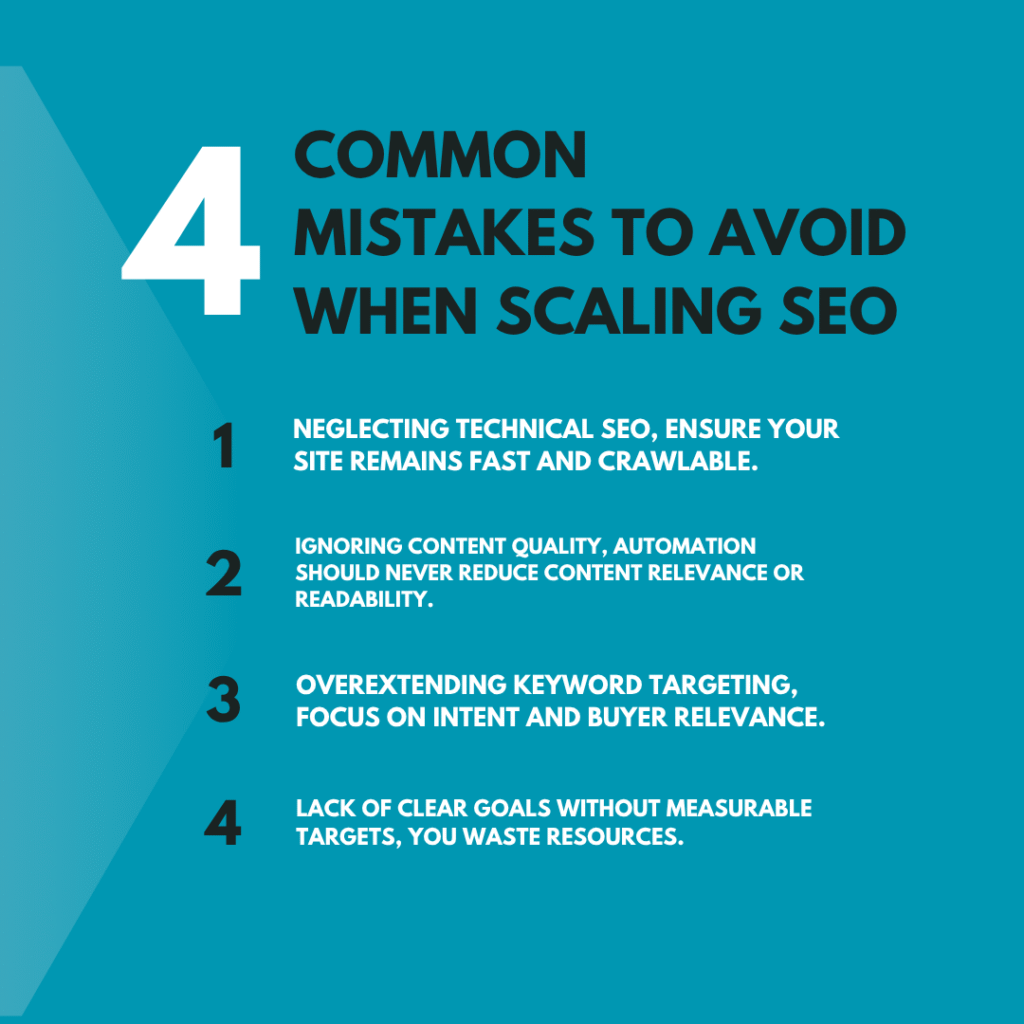
Scaling SEO is powerful but risky if done poorly. Avoid these pitfalls:
- Neglecting technical SEO Ensure your site remains fast and crawlable.
- Ignoring content quality Automation should never reduce content relevance or readability.
- Overextending keyword targeting Focus on intent and buyer relevance.
- Lack of clear goals Without measurable targets, you waste resources.
The Future of SEO Is Scalable and AI-Driven
SEO will keep evolving with AI and machine learning at its core. B2B companies will personalize content at the account level. eCommerce brands will deliver hyper-relevant experiences based on user behavior. AI tools will handle more of the heavy lifting, but human creativity will remain essential. Scalable SEO services are not just a trend; they are the future.
Conclusion
If your SEO can’t grow with your business, it will hold you back. By combining AI SEO Solutions, scalable B2B SEO Strategies, and E-Commerce SEO Services, you build a powerful growth engine. Add a solid technical SEO foundation and strategic link building, and your website will rank higher and convert better, no matter how big you get. Invest in Scalable SEO services today to stay competitive tomorrow.
FAQs
What is the best AI to use for SEO?
The best AI to use for SEO depends on your goals. Tools like Surfer SEO, Clearscope, and SEMrush’s AI features help optimize content. Jasper AI assists with writing, while ChatGPT supports idea generation. Combining these tools ensures precise keyword targeting, high-quality content, and improved search rankings efficiently.
What is B2B in SEO?
B2B in SEO means optimizing your site to attract business clients, not just consumers. It involves targeting industry-specific keywords and creating authoritative content. Using B2B SEO services to generate leads helps businesses reach decision-makers, build trust, and drive high-quality leads through longer sales cycles.
Is AI better than SEO?
AI and SEO serve different but complementary roles. AI enhances SEO by automating tasks like keyword research and content optimization, making strategies more efficient. However, SEO focuses on building organic visibility and user trust. Together, AI and SEO create smarter, faster, and more effective marketing results.
What are the 4 types of B2B marketing?
The four main types are content marketing, email marketing, social media marketing, and SEO. Using proven SEO strategies to grow organic traffic boosts visibility and lead generation, helping businesses nurture relationships and achieve long-term success in B2B markets.
What is the best SEO for B2B?
The best SEO for B2B combines targeted keyword research, in-depth content like case studies, and strong backlinks. Using Scalable SEO and B2B SEO services to generate leads helps you reach decision-makers, support long sales cycles, and grow your business with a flexible, growth-ready strategy.
Which technology is best for SEO?
The best technology for SEO combines Google with AI-powered tools, such as ChatGPT and SEMrush, with platforms like WordPress or Shopify. Utilizing scalable SEO services powered by these technologies helps automate keyword research, optimize content, perform site audits, and efficiently improve rankings as your business grows.
What is the AI tool to check SEO?
Popular AI tools like SEMrush, Ahrefs, and Moz use AI to audit websites, analyze keywords, and track rankings. They help improve site performance by identifying issues and recommending high-quality content for SEO ranking, enabling marketers to optimize effectively and stay ahead of competitors.