Creating a Social Media Viral Video depends on capturing immediate attention in a saturated digital landscape. Audiences scroll past hundreds of posts daily, meaning your content must stop them instantly. While algorithm updates continuously shift organic reach, human psychology remains constant. The secret to consistent performance lies in understanding how to hook viewers within the first three seconds. In this guide, you will learn the exact hooks, structure, and retention strategies needed to maximize reach across short-form video platforms.
Key Takeaways
- Hooks Decide Reach: The first 3 seconds determine whether a user continues watching or scrolls past.
- Pattern Interrupts Drive Retention: Disrupting visual or auditory expectations prevents drop-off.
- Algorithm Synergy: Platforms prioritize watch time, completion rate, and shares above simple likes.
- Strategic Call to Action: High retention must be paired with clear engagement prompts to signal value to the algorithm.
- Professional Execution: Combining organic creativity with a structured social media strategy ensures long-term brand growth.
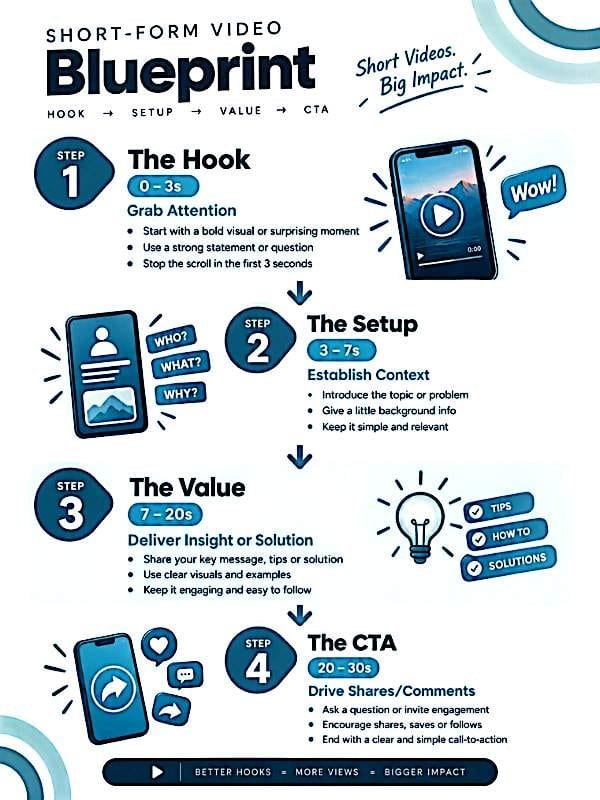
What Makes a Social Media Video Go Viral?
There is no magic button for guaranteed virality, but algorithms on platforms like Instagram Reels, TikTok, YouTube Shorts, and Facebook Reels follow distinct patterns. These recommendation engines prioritize content based on audience retention, watch time, completion rate, and social shares.
When a user opens a feed, the platform tests new content on a small sample audience. If that initial group watches the video past the halfway mark, rewatches it, or sends it via direct message, the distribution expands to a larger audience segment. Understanding Instagram Creator Guidelines or official platform documentation helps clarify how algorithms analyze user signals.
Key factors that contribute to high organic distribution include:
- High Initial Retention: Keeping 70% or more of viewers past the 3-second mark.
- Watch Time and Rewatches: Videos that loop seamlessly encourage repeat views.
- Shares over Likes: Direct messages and external shares carry heavier weight in recommendation models.
- Comment Triggers: Encouraging debate, questions, or relatable observations in the comment section.
Why the First 3 Seconds Matter (The Power of Video Hooks)
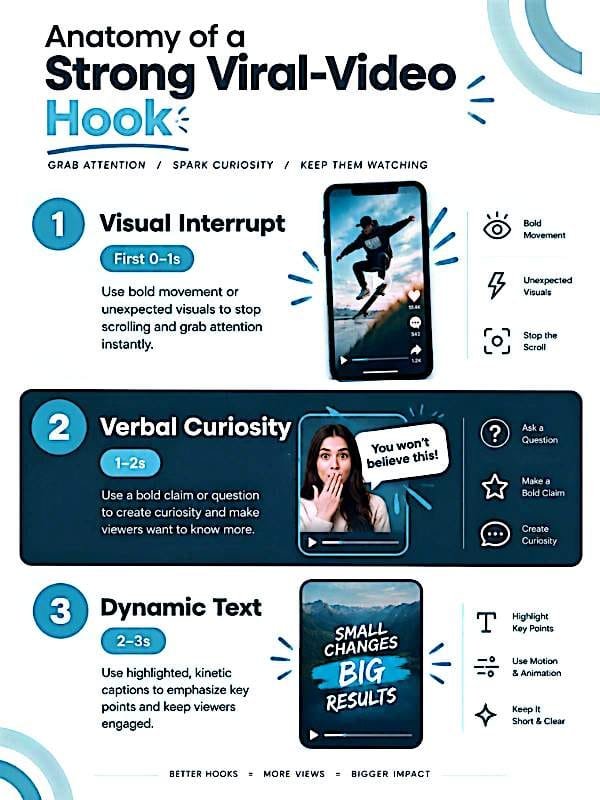
Modern short-form video platforms operate in a high-speed, fast-scrolling environment. Viewers make a subconscious decision to stay or swipe away in under three seconds. This brief window is where your visual and verbal hook operates.
A video hook disrupts the user’s scrolling habit by introducing curiosity, tension, visual interest, or relatable problem-solving. Without a compelling hook, even high-budget production value goes unnoticed. Mastering viral video hooks gives your content the leverage required to maximize viewer retention and watch time.
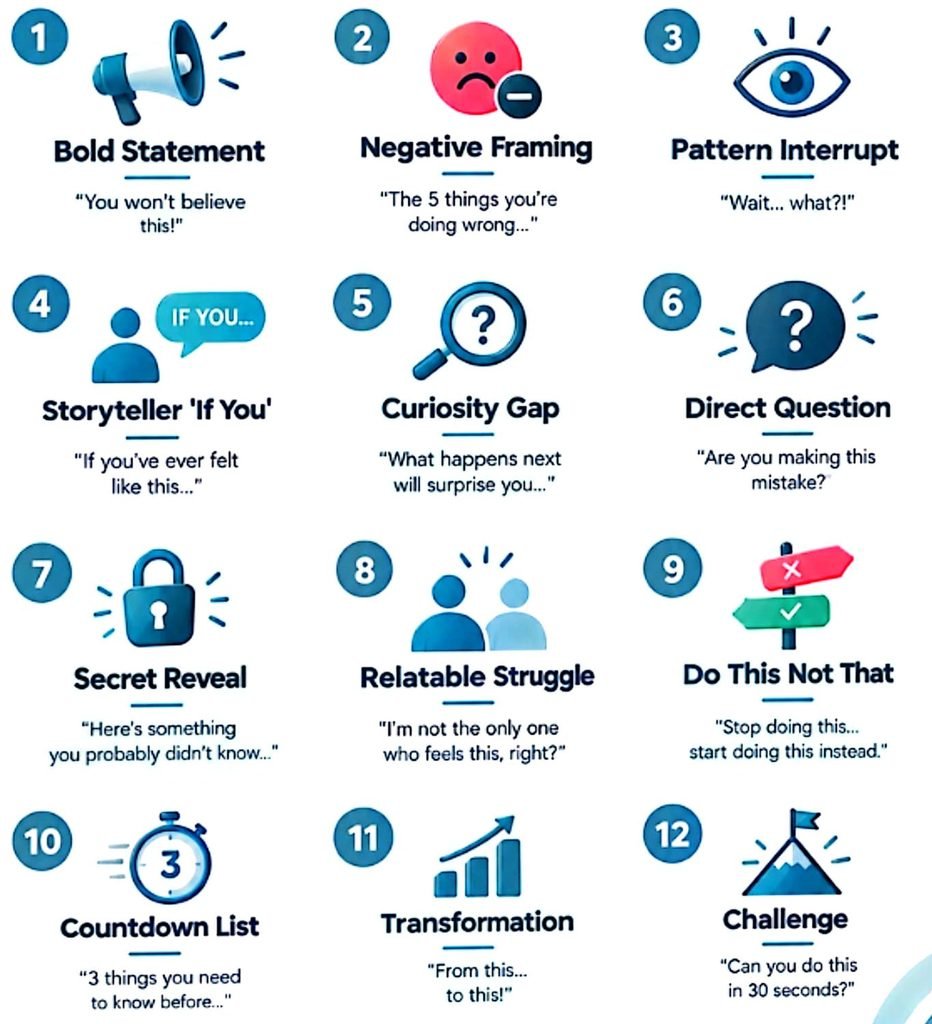
12 Proven Viral Video Hooks for Social Media
Here are 12 field-tested social media video hooks you can adapt across industries, niches, and video formats.
1. The Bold Statement Hook
Concept: State a counterintuitive, controversial, or surprising fact right at the beginning.
Why It Works: It creates immediate cognitive dissonance, forcing the viewer to watch further to see how you justify the claim.
When to Use It: Ideal for debunking myths, sharing industry secrets, or presenting original research.
Example: “Stop posting daily on social media if you actually want to grow.”
2. The Negative Framing Hook
Concept: Highlight a mistake, warning, or action the viewer should avoid.
Why It Works: Human psychology is wired to avoid risk and loss more strongly than acquiring gain (loss aversion).
When to Use It: Educational content, tutorials, and business advice.
Example: “If you are still using this hashtag strategy, you are killing your reach.”
3. The Visual Pattern Interrupt Hook
Concept: Start with an unexpected visual action, movement, or unusual camera angle.
Why It Works: It snaps the viewer out of passive auto-scrolling by disrupting visual expectation.
When to Use It: Product demonstrations, lifestyle content, and creative storytelling.
Example: Pouring a liquid backward or dropping an object directly toward the lens before speaking.
4. The Storyteller “If You…” Hook
Concept: Call out a specific demographic or situation directly in the opening phrase.
Why It Works: Creates instant self-selection. Viewers matching the profile feel the content is tailored specifically to them.
When to Use It: Niche-specific advice, local business targeting, or B2B marketing.
Example: “If you are a startup founder struggling with video views, listen to this.”
5. The High-Stakes Curiosity Gap Hook
Concept: Show the compelling end result first without revealing how it was achieved.
Why It Works: Builds an intense desire to close the curiosity gap by watching the process unfold.
When to Use It: DIY, transformations, design, case studies, and tutorials.
Example: “We generated 100k views with zero ad spend, and here is the exact script we used.”
6. The Direct Question Hook
Concept: Ask a thought-provoking question that touches on a common frustration or desire.
Why It Works: The brain naturally seeks to answer questions it hears, locking in viewer focus.
When to Use It: Explainer videos, problem-solving services, and product highlights.
Example: “Ever wonder why your short-form videos get stuck at 200 views?”
7. The “Secret/Hack” Reveal Hook
Concept: Frame your insight as an insider shortcut, hidden feature, or industry secret.
Why It Works: Appeals to the human desire for efficiency and exclusive knowledge.
When to Use It: Tech tips, productivity tools, and growth strategies.
Example: “Here is a secret editing setting that top creators do not want you to know.”
8. The Relatable Struggle Hook
Concept: Express a universal pain point, emotion, or shared experience in a humorous or empathetic way.
Why It Works: Fosters instant emotional connection and validation, driving comment-section conversations.
When to Use It: Skits, personal brand storytelling, and consumer products.
Example: “That feeling when you spend 3 hours editing a video and it gets 12 views.”
9. The “Do This, Not That” Hook
Concept: Compare a bad habit directly against a superior alternative in a side-by-side format.
Why It Works: Provides immediate practical value with minimal cognitive overhead.
When to Use It: Comparisons, software demonstrations, fitness form checks, and design tips.
Example: “Stop framing your video like this; do this instead for higher engagement.”
10. The Countdown/Listicle Hook
Concept: Promise a specific, numbered set of actionable items or ideas.
Why It Works: Gives clear structural expectations and encourages viewers to watch until the top recommendation.
When to Use It: Resource curation, tool roundups, and list-based tutorials.
Example: “3 free AI tools that will save you 10 hours of video editing every week.”
11. The Transformation/Before-and-After Hook
Concept: Display a dramatic contrast between a starting point and a final outcome immediately.
Why It Works: Visual transformation is universally engaging and provides quick social proof.
When to Use It: Fitness, renovation, graphic design, branding, and video editing showcases.
Example: “Here is what this client page looked like before and after our strategic redesign.”
12. The Challenge/Experiment Hook
Concept: Document a real-world test, personal challenge, or time-bound experiment.
Why It Works: Introduces narrative stakes, urgency, and continuous interest in the outcome.
When to Use It: Case studies, content challenges, and product durability testing.
Example: “I tested 30 short-form video hooks over 30 days, and here are the results.”
Comparison of the 12 Viral Video Hooks
| Hook Type | Core Purpose | Primary Emotional Trigger | Ideal Platform / Format |
|---|---|---|---|
| Bold Statement | Challenge common assumptions | Surprise / Curiosity | TikTok, Instagram Reels |
| Negative Framing | Prevent mistakes or risk | Loss Aversion / Caution | YouTube Shorts, LinkedIn Video |
| Visual Pattern Interrupt | Stop scrolling motion instantly | Visual Intrigue | Instagram Reels, TikTok |
| Storyteller “If You…” | Qualify target audience | Personal Relevance | TikTok, Facebook Reels |
| Curiosity Gap | Hold attention until payout | Anticipation | YouTube Shorts, Instagram Reels |
| Direct Question | Engage analytical thinking | Inquiry / Problem Solving | LinkedIn Video, Facebook Reels |
| Secret / Hack Reveal | Provide exclusive value | Desire for Efficiency | TikTok, YouTube Shorts |
| Relatable Struggle | Build community empathy | Validation / Humor | Instagram Reels, TikTok |
| Do This, Not That | Compare actionable methods | Clarity / Optimization | YouTube Shorts, Instagram Reels |
| Countdown / Listicle | Deliver structured resources | Organized Utility | TikTok, Instagram Reels |
| Transformation | Display undeniable results | Aspiration / Proof | Instagram Reels, TikTok |
| Challenge / Experiment | Document real-time journey | Suspense / Storytelling | YouTube Shorts, TikTok |
Analyzing Real-World Examples of Viral Video Execution
Analyzing successful short-form video content helps illustrate how hooks operate in real environments. Studying successful creators on channels like the YouTube Creators Channel provides insights into effective pacing and visual hierarchy.
Example 1: Analytical Breakdown & Practical Hacks
Platform: YouTube Shorts
URL: https://www.youtube.com/shorts/51IOn38S68I
What It Does Well: Combines immediate movement with rapid, punchy text overlays to establish immediate context without relying solely on audio.
Hook Demonstrated: Secret/Hack Reveal Hook paired with Visual Pattern Interrupt.
Takeaway: Always back up visual hooks with clear dynamic captions. Over 60% of short-form videos are initially viewed on mute or in low-volume settings.
Example 2: Rapid Concept Demonstration
Platform: YouTube Shorts
URL: https://www.youtube.com/shorts/v_S3I_8x-N4
What It Does Well: Opens directly in the middle of an action sequence, completely bypassing traditional intro music or greetings.
Hook Demonstrated: High-Stakes Curiosity Gap Hook.
Takeaway: Cut out filler words in your edit. Start your video at the exact moment of tension or activity.
Example 3: Relatable Problem-Solving
Platform: YouTube Shorts
URL: https://www.youtube.com/shorts/3P_YxP1N6y0
What It Does Well: Speaks directly to a specific audience frustration and immediately shows a clear side-by-side solution.
Hook Demonstrated: “Do This, Not That” Hook.
Takeaway: Clearly defined contrasts allow viewers to consume and digest value quickly, making them more likely to share the video with colleagues or friends.
Advanced Video Retention Strategies (Beyond the Hook)
While a great hook gets viewers to stop, retaining them requires thoughtful pacing, editing, and audio design. High watch time tells platform recommendation engines that your video is worth pushing to broader audiences.
Consider implementing these core retention techniques:
- Pacing and Jump Cuts: Remove all pauses, breaths, and unnecessary filler words. Keep the speech brisk and active.
- Dynamic Text Overlays: Use auto-captions with highlighted keywords to reinforce spoken points visually.
- B-Roll and Visual Swaps: Change camera angles, zoom levels, or visual elements every 2 to 3 seconds.
- Audio Cues and Trending Sound Design: Use clean voiceovers paired with subtle background audio or trending sound bites to elevate production value.
- Open Loops: Mention an upcoming takeaway mid-video to encourage viewers to stay until the final frame.
Turning Short-Form Views into a Sustainable Strategy
Achieving high view counts is a powerful top-of-funnel signal, but views alone do not build a business. Converting casual video viewers into loyal customers requires a unified marketing infrastructure.
For brands and businesses looking to convert short-form engagement into measurable revenue, partnering with experienced professionals is crucial. Utilizing specialized Social Media Marketing services in Pakistan allows organizations to align viral video hooks with lead capture systems, sales funnels, and brand positioning.
When short-form video content is integrated into a complete digital ecosystem, every spike in view counts supports long-term customer acquisition. Working alongside a full-service digital marketing agency ensures that social video efforts are backed by paid advertising, technical search optimization, conversion tracking, and structured content calendars.
By connecting content creation with business goals, brands managed by a leading digital agency in Pakistan transform simple social media video views into long-term brand equity.
Frequently Asked Questions (FAQs)
1. How long should a social media video be to go viral?
Optimal length varies by platform, but short-form videos lasting 15 to 30 seconds generally yield higher completion rates. If your narrative requires more time, focus on keeping pacing tight across 60-second formats.
2. Do I need professional equipment to create engaging social media videos?
No. Most viral short-form content is shot on modern smartphones. Clear audio, good lighting, and strong hook concepts matter far more than expensive camera gear.
3. How frequently should I post short-form video content?
Consistency is key. Posting 3 to 5 high-quality short-form videos per week gives platform algorithms enough data to find and index your target audience.
4. What is the most important metric for video virality?
Average watch time and completion rate are the primary performance indicators. High share counts are also heavily favored by distribution algorithms.
5. Can B2B brands use short-form viral hooks effectively?
Yes. B2B brands can use educational hooks, “Do This, Not That” comparisons, and case study breakdowns to attract high-intent professional clients.
6. Should I add text captions to all my short-form videos?
Yes. Many users watch videos on mobile devices with sound turned off. Dynamic captions ensure your message is delivered regardless of audio settings.
7. How do I turn short-form video views into real business leads?
Direct viewers to a specific action by including a clear call to action in the final frame or caption, directing them to dedicated landing pages or service inquiries.